How do VIM30CP and VIM40CP compare?
Their published powers are 30W and 40W respectively, with the same 10.6 μm wavelength. They belong to the portable VIM-CP CO2 series, whose other entries are 60W, 100W and 150W.

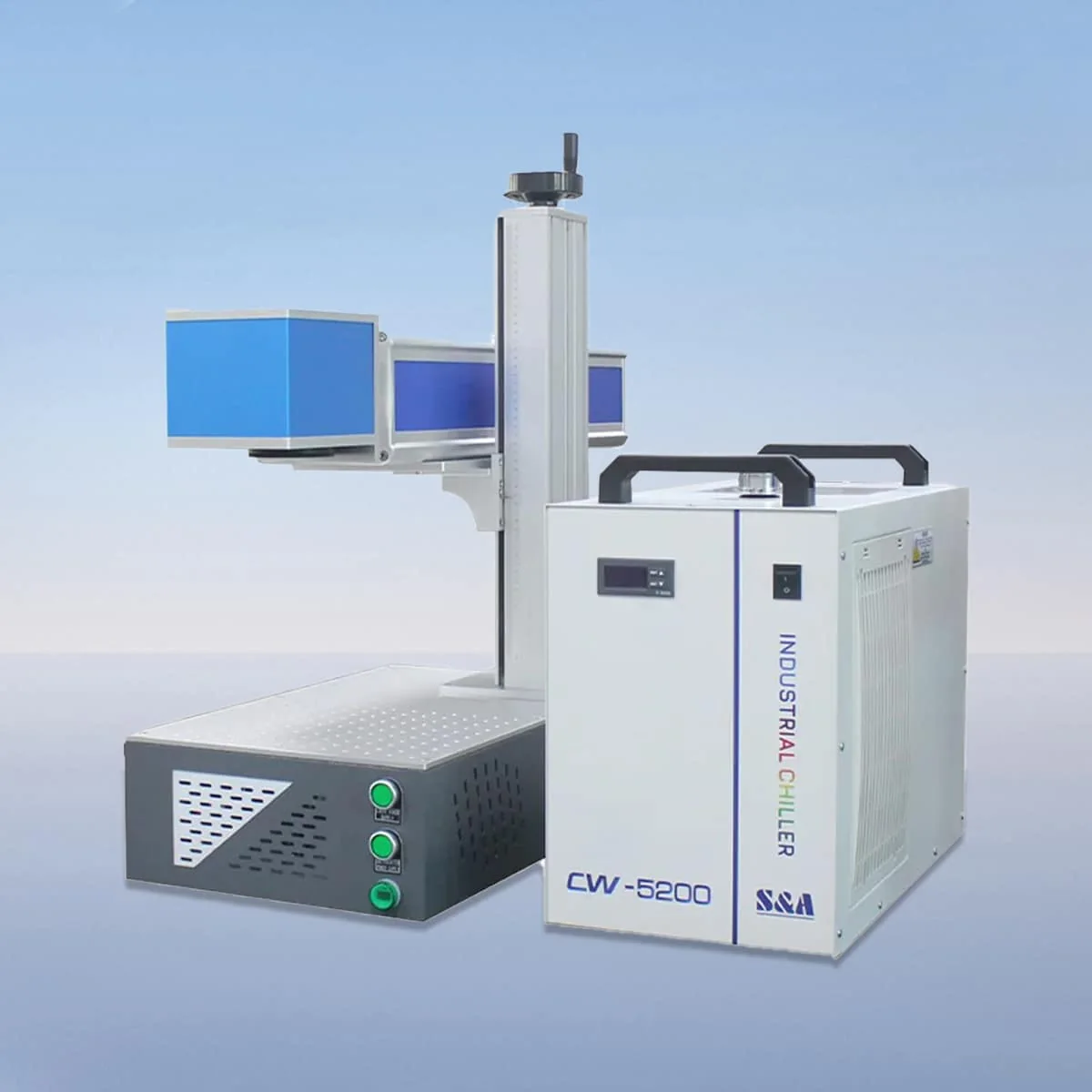
Laser Marking Machine
VIM-CP is a portable CO2 laser marking machine series. Its five models are VIM30CP, VIM40CP, VIM60CP, VIM100CP and VIM150CP, corresponding to 30W, 40W, 60W, 100W and 150W. The published wavelength is 10.6 μm across the range. Portable design describes the equipment arrangement, with the actual installation requirements to be established for the selected machine.
The configuration includes a CO2 laser tube and air cooling, plus a galvo scanner, field lens and red dot pointer. Parameter settings, adjustment and real-time monitoring are described for the control system. These features give the setup discussion a concrete basis when a buyer needs to consider more than one working position.
Choose an individual model below to view its complete technical specification. The series overview shows selected parameters for comparison.
The portable arrangement is intended for movement and setup in different work locations. Before planning relocation, obtain the machine dimensions, weight and connection requirements. The source provides no weight or battery specification here, so portability should not be interpreted as single-handed carrying or operation without the required services.
VIM30CP and VIM40CP are the 30W and 40W choices. The 60W, 100W and 150W models widen the power range without changing the listed wavelength. Selection should refer to the actual material and marking task; the power label does not establish a mark depth or production rate on its own.
The red dot pointer gives a visible positioning reference. When equipment will be set up at several locations, keep the workpiece reference edges and mark position consistent in the setup information. The galvo scanner and field lens are part of the optical configuration, which should be identified alongside the selected laser model.
The published nonmetal application scope includes marking and engraving on plastic, glass, rubber and wood. Specify the precise material and surface treatment in your request, and show the result you need in terms of mark size, position and appearance. Naming a material family does not establish suitability for every formulation or surface condition.
If the task moves between workstations, describe each location and the parts presented there. Include how the object will be supported, where the operator can access the marking surface and where the equipment can stand. These details help distinguish a genuine relocation requirement from a task better organized around one fixed marking station.
Ask for the marking field, optics and control details for the proposed portable configuration. None of those dimensions or software brands is inferred from another CO2 series. Artwork should be supplied at its intended size, with the mark location identified on the part drawing, so that the optical setup is discussed around a defined task.
Air cooling and an interlock are described. The interlock stops operation when a safety door or panel opens. Obtain the operating and setup instructions for the offered arrangement, including the protective provisions at each intended work location. A portable design does not by itself establish an outdoor rating or a safety classification.
Keep a short setup record for each intended station: available space, workpiece support, required connections and the drawing revision used for the job. In the equipment request, distinguish the marker from any stands, supports or handling accessories you want discussed. This gives the configuration review a clear scope without assuming those items accompany the machine.
Their published powers are 30W and 40W respectively, with the same 10.6 μm wavelength. They belong to the portable VIM-CP CO2 series, whose other entries are 60W, 100W and 150W.
No battery specification is provided here. Obtain the power and connection requirements for the offered machine before planning how it will be moved or used at different work locations.
The published scope includes plastic, glass, rubber and wood for marking and engraving. Identify the exact substrate and surface rather than treating that list as approval for every material variant.
The configuration includes a red dot pointer for visible positioning. Supply a drawing showing reference edges and the desired mark location when reviewing the setup for each workpiece.
Confirm dimensions, weight, connections, workpiece support and the operating arrangement at each location. Keep requested accessories separate from the marker itself when defining the equipment package.
Share your material, dimensions and process. Start a conversation about the right configuration.